Arabic original title: !ترامب يغزو أوروبا
Original publication: Al Joumhouria Newspaper
Publication date: January 22, 2026
Original Arabic article: https://www.aljoumhouria.com/ar/news/794503/
This article forms part of Joseph Deeb’s Trumponomics Doctrine series. It examines Europe not as a passive ally of the United States, but as a strategic theatre where sovereignty, security, tariffs, military dependence, industrial weakness, and political leverage intersect. In this reading, “Trump invades Europe” is not a military claim, but an economic and strategic diagnosis: Europe is being forced to confront the cost of protection, the limits of alliance language, and the new reality of post-Trumponomics power.
English translation / adapted English version:
Trump Invades Europe
Not with tanks, but with conditions that make “no” costly, “yes” a settlement, and the European decision a line item that can be priced.
Here, borders are not drawn on maps; they are written on invoices.
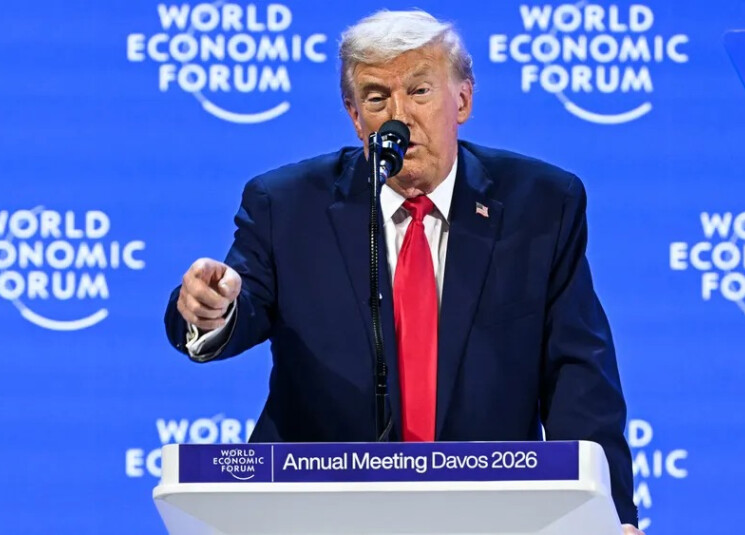
Is Donald Trump, the forty-seventh President of the United States, really invading Europe? If invasion means tanks, the answer is no. But if invasion means re-engineering the very meaning of sovereignty so that Europe’s options are managed through cost, pressure, and tempo, then Davos was not a reassuring speech. It was the announcement of a phase in which the continent is governed by conditions rather than by maps. Trump said he would not use force to acquire Greenland, then returned to demand immediate negotiations on it. In that paradox, the real question is born: if force is not the tool, what is? The answer is not purely political, but geoeconomic: a diplomacy that prices sovereignty, escalates cost, and seeks the upper hand in negotiations before negotiations even begin.
In Davos, on the sidelines of the World Economic Forum, Trump offered what looked like a verbal de-escalation when he said he would not use force to acquire Greenland. He then immediately came back to demand immediate negotiations and to place before Europe and NATO an equation rarely spoken among allies with such bluntness: either consent that is received as “gratitude,” or refusal accompanied by a political “memory” that does not forget. This is not the language of military war. It is the language of a war of conditions, a war of minds, tactics, and calibrated pressure, designed so that the other side enters negotiations feeling it is defending itself, not negotiating from a position of full sovereignty.
This is precisely why the title “invades Europe” becomes understandable rather than exaggerated. The new invasion is not the occupation of land, but the occupation of European decision-space. It is done not through a rifle on a border, but by turning sovereignty into an economic invoice and turning a political position into a measurable cost. The threat of tariffs that start and then escalate does not function as a passing trade story. It functions as a pressure system that forces capitals to recalculate their stance according to a ledger of losses and gains: a cost on trade, a cost on growth, and a cost on supply chains. At that point, the conflict is no longer a legal debate about the principle of sovereignty. It becomes a struggle over who holds the right to price Europe’s choices.
Yet what is most effective in the Davos framing is that Trump did not present the matter as a property dispute, but as global security. He said Greenland is necessary for security, and even claimed that the United States alone is capable of securing it. This wording redefines the problem. Instead of the sovereignty of Denmark and Greenland, it becomes security competence. Instead of refusal being a legitimate sovereign stance, it becomes obstruction to a universal necessity. Europe is dragged into a new logic: it must justify its sovereignty before a discourse that implicitly casts it as an obstacle to a security presented as a global fate.
But behind the word “security” lies a harsher economic core: whoever writes the conditions owns the gains. Here, Trumponomics Doctrine enters not as decorative analysis, but as a map explaining why the denial of force matters less than the engineering of pressure itself. The doctrine says plainly that influence is not measured by what you own on paper, but by what you can impose as practical reality through trade, tariffs, supply chains, and energy. That is why it foregrounds Resource Hegemony, dominance over resources, as the ability to control the terms of access to minerals, corridors, and markets. It pairs that with the External Revenue Service, ERS, as a logic of shifting cost outward. It rests on Energy Sovereignty in its practical meaning: expanding internal abundance so that pressure on others becomes a cost on them, not a cost on you, summed up by Trump’s famous slogan, Drill, Baby, Drill, meaning pushing for more drilling and production to increase supplies and reduce dependence on others. All of this is conducted through Economic Narrative Warfare, the narrative of geoeconomic war, which is the crafting of a story that persuades the world that coercion is realism, that imposing conditions is protection, and that changing the rules is necessity, not aggression.
If Davos had to be condensed into one sentence outside the usual political analysis, it would be this: Trump did not cancel the objective; he changed the means of reaching it. He moved from the logic of acquisition by force to acquisition by conditions, and from the language of war to the language of geoeconomic diplomacy that turns refusal into a cost, then reclassifies that cost as the responsibility of the refuser, not the demander. That is why surface headlines mislead. The rhetoric may soften the terminology, but the structure of the demand, the rhythm of threat, and the ceiling of tariffs all move according to one logic: writing the terms of access to resources, corridors, and positioning, and closing competitive doors through rules rather than occupation.
Then Energy Sovereignty becomes the fuel of this psychological and tactical form of invasion. When the central discourse is internal abundance, pressure on the outside becomes easier. The party with an energy surplus treats cost as an instrument it can bear, while the other side bears it as a direct threat to its economy, industry, and social cohesion. This is not a passing line in Trumponomics Doctrine. It is a pillar explaining how economics becomes a condition imposed on politics, and how major equations are managed without gunfire.
What makes the moment more dangerous than an exchange of statements is the insertion of NATO into an openly economic equation. When allies are told do not obstruct, or we will remember, this is not the language of partnership. It is a test of the limits of obedience within the alliance, and a quiet transformation of NATO from a security umbrella into a platform for passing conditions. Here, the conflict becomes geopolitical rather than military: a battle over defining sovereignty, a battle over who sets the rules of the game, and a battle over who controls the right to interpret security as an economic mandate rather than a defensive obligation.
The danger in Davos is not that Trump lowered the tone of force. It is that he shifted the center of gravity from force to scheduling: a cost that escalates, pressure that rises, and an equation managed slowly until alternatives become limited. This is not only a Greenland crisis. It is Europe being tested before a new model of governance, continents driven by economics as they once were driven by weapons. From here, the true chapter begins: either Europe understands that what is happening is not a passing dispute but the engineering of a new reality, or it will later wake up to find that Davos was not a forum. It was an invisible signature.
Concept reference: The Trumponomics Doctrine, as presented in The Official Birth of the Trumponomics Doctrine / TRUMPONOMICS: THE NEW WEALTH OF NATIONS, originally published by Joseph Deeb on LinkedIn on April 6, 2025, and now available in its official web edition at TrumponomicsDoctrine.com.
Official doctrine page:
https://trumponomicsdoctrine.com/the-official-birth-of-the-trumponomics-doctrine/