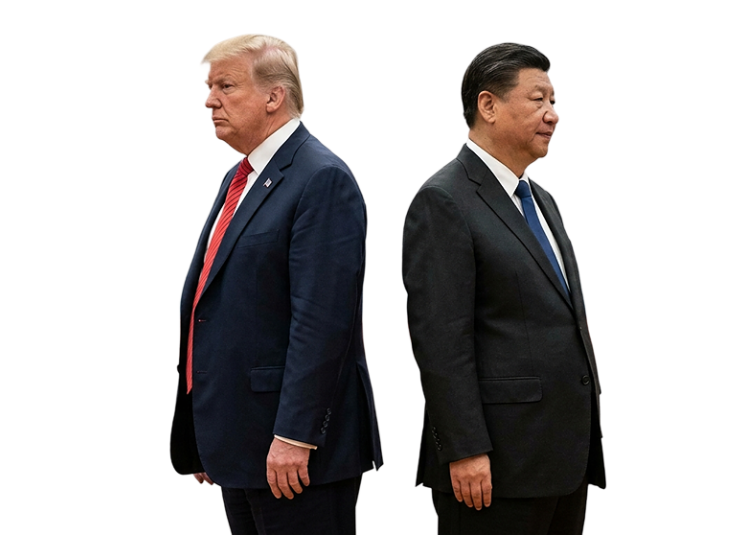
Arabic original title: ترامب يخفي هدفاً أكبر ممّا يعلنه
Original publication: Al Joumhouria Newspaper
Publication date: March 11, 2026
Original Arabic article: https://www.aljoumhouria.com/ar/news/801146/
This article examines the wider target behind Trump’s apparently separate moves toward Greenland, Canada, Panama, Venezuela, Iran, and Cuba. It argues that these theatres are not isolated files, but connected pressure points in a broader strategy of constraining China’s rise, controlling energy access, tightening strategic geography, and reshaping the economic corridors that link resources, trade, security, and global power. In this reading, the declared target is only the visible layer, while the deeper objective is the containment of China through geography, energy, routes, and leverage.
English translation / adapted English version:
Trump Hides a Bigger Target Than He Declares
It is not easy to read U.S. President Donald Trump’s moves from Greenland to Canada to Panama to Venezuela to Iran to Cuba as merely a set of arenas that appear, on the surface, to be unrelated, driven by a president who raises the stakes and then bargains over the political price and financial return. That reading now seems incomplete, because China is at the center of this picture, not merely one actor within it. What appears on the surface as shifting escalation may, at a deeper level, be a single course of action whose ultimate aim is not simply to secure a deal, impose tariffs, or extract a quick concession, but to encircle China and crush its rise under Chinese President Xi Jinping before it completes its transformation into a full strategic, economic, and technological rival to the United States.
Some Western research centers have come close to parts of this picture. They saw in Iran and Venezuela pressure on China through the energy gateway, and in Greenland, Canada, and Panama a hardened American stance toward the Western Hemisphere. But they remained captive to partial descriptions of each file and did not reach the point of naming the broader objective that may connect all these arenas. They touched some features of the picture, yet did not say that bringing these arenas together reveals a larger goal, namely the encirclement of China and the curbing of its rise. This reading therefore does not begin where those centers ended, but where they stopped connecting the dots, because what looks like separate crises may in fact be a gradual pressure campaign tightening around China from more than one direction and at more than one level.
In the north, Greenland does not appear to be a cold geographic detail, but rather a forward position in the Arctic, rich in minerals and highly sensitive in any long-term struggle over resources, positioning, and control of upper routes. When Trump places Russia alongside China in justifying his hard line there, he gives his rhetoric a broader cover. Yet the real weight in this arena remains more Chinese than Russian, because China is the one that needs to expand its presence in Arctic routes, new resources, and distant transit points. Russia, by contrast, is already a major Arctic power, possessing such geographic expanse and such abundant resources that the need for Greenland is far less urgent for it. In Canada as well, Trump’s objection to any understanding with Beijing was not merely a passing trade dispute, but an objection to Canada becoming a Chinese gateway into the U.S. market. At that point, the north, from Greenland to Canada, becomes an early line of defense against any direct or disguised Chinese expansion into the American economic and security sphere.
In America’s near strategic space, this meaning becomes even clearer. Panama is not merely a dispute over ports or facilities. It is the Panama Canal, a maritime passage linking two oceans and granting whoever secures a foothold around it an influence that extends beyond its borders into global trade itself. Reducing Chinese influence in the areas surrounding the canal means denying Beijing a foothold at one of the most sensitive crossings in the world. Cuba, meanwhile, does not enter the picture simply as a hostile island, but as a point that could turn into an advanced outpost in the United States’ nearby flank. That is why tightening the noose around it after Venezuela does not seem disconnected from the idea of cleansing America’s near sphere of any Chinese presence capable of turning into fixed influence or a pressure lever.
Then we reach the energy and monetary core of the matter, namely Venezuela and Iran. Here, the connection to China becomes less speculative and more solid, because the issue is not only about two important energy suppliers, but also about two arenas that helped Beijing operate with a broader margin outside the full grip of the dollar, and specifically through the yuan. Pressure on Venezuela is therefore not merely a reset of America’s near sphere, but a blow to a convenient source for China inside Latin America. Iran is even deeper in significance, because it is not only a political ally of Beijing, but one of the most important energy sources from which China benefited by securing low-cost oil outside strict Western constraints. The blow therefore does not strike only the flow of cheap oil; it also strikes a broader Chinese attempt to expand the yuan’s presence in cross-border trade. When Iran is hit and Venezuela is reshaped, what is damaged is not only two political regimes, but part of the margin China used to widen its room for maneuver outside the full Western grip. From this angle, the blow also extends to one of the practical promises that BRICS has marketed in recent years: expanding trade in local currencies and reducing reliance on the dollar. China, as a founding member and a central heavyweight in this bloc, is not merely losing cheap barrels of oil. It is also losing a sphere that had helped give practical meaning to the idea of conducting transactions outside the U.S. currency, thereby undermining the credibility of the promise BRICS tried to offer the world.
When these arenas are brought together into a single picture, an answer begins to impose itself: Trump may be hiding a larger objective than he admits. On the surface, he may appear to be a president chasing deals and financial return, but the deeper structure of his moves suggests that he is working on something far bigger: the encirclement of China and the crushing of its rise across geography, energy, routes, economic and monetary influence, and currency dominance, before its positioning is complete as a power capable of imposing a new balance with the United States. In the language of strategy, this recalls the logic of Komatsu when it raised the Maru-C slogan to encircle Caterpillar, that is, choking the rival from the edges and gradually narrowing its space instead of relying only on direct confrontation. From this angle, Trump’s moves do not look so much like the management of scattered crises as they do a path toward encircling China from more than one direction. And when the map is read as a whole, the assumption of roaming chaos falls away, and a more coherent possibility emerges: these arenas that seem far apart are merely parts of a tightening ring meant to close around China before it reaches the moment of full parity with Washington.
Series reference: This article appears within Joseph Deeb’s wider Trumponomics Doctrine Series & Global Geopolitics / Geoeconomics writings, where great-power rivalry is examined through leverage, energy, corridors, geography, and strategic pressure.
Official doctrine page:
https://trumponomicsdoctrine.com/the-official-birth-of-the-trumponomics-doctrine/