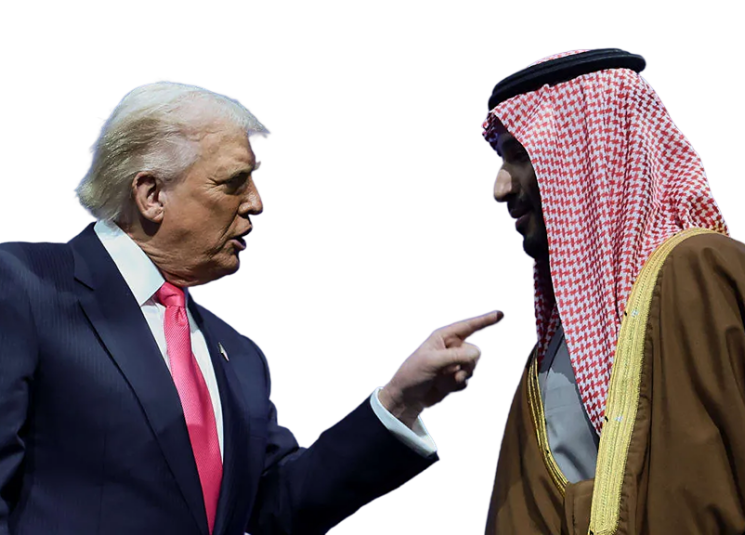
Arabic original title: محمد بن سلمان لن ينسى الإهانة التي وجّهها إليه ترامب
Original publication: Al Joumhouria Newspaper
Publication date: April 9, 2026
Original Arabic article: https://www.aljoumhouria.com/ar/news/806269
This article examines Trump’s public insult toward Saudi Crown Prince Mohammed bin Salman as more than a personal or rhetorical mistake. It reads the episode through the deeper structure of Saudi-American relations, dignity, reciprocity, energy security, Gulf leverage, Europe’s renewed strategic need for Saudi Arabia, the Abraham Accords file, and Riyadh’s ability to delay, raise the price, or redirect political rewards sought by Washington.
English translation / adapted English version:
Mohammed bin Salman Will Not Forget the Insult Trump Directed at Him
When U.S. President Donald Trump spoke about Saudi Crown Prince Mohammed bin Salman in humiliating terms at the Saudi-backed “Future Investment Initiative” in Miami, the problem was not in the verbal vulgarity alone, but in the fact that he publicly lowered the level of a relationship that was not built on humiliation, nor was it framed as the language of master and subordinate. From its origin, it was a relationship in which each side needed the other at a decisive historical moment. For this reason, Saudi silence is not to be read here as confusion or weakness, but rather as a signal that what was said has been recorded, and that its answer may come later in a place that is far more painful politically, especially at a moment when Saudi Arabia is no longer a party that can be dealt with lightly, because the need for it increases every time the need expands to consolidate the truce, reopen Hormuz, and restore a degree of regional stability.
To understand the meaning of this mistake properly, one must return to the origin of the U.S.-Saudi relationship itself, because the meeting between U.S. President Franklin Roosevelt and King Abdulaziz aboard the cruiser Quincy in 1945 was not merely a protocol event, but rather a founding moment for a relationship based on mutual benefit and mutual recognition of standing. From this perspective, the most accurate description of that foundation is that it took place on the basis of political parity, not on the basis of subjugation. That is, each side understood the value of what the other possessed, and dealt with it on that basis. This is precisely what Trump misread, because he acted as though this relationship could be lowered to a register beneath its historical register without cost.
This meaning did not remain confined to historical symbolism. It later appeared in the actual structure of the relationship between oil and sovereignty, because Aramco itself provides the clearest example that Saudi Arabia was never merely an oil تابع. The company began under an American concession, then the Kingdom gradually moved to increase its share until it reached full ownership in 1980. Yet Saudi Arabia did not shut itself off. It kept weighty Western names within the company’s structure when it saw benefit in that, meaning that it absorbed expertise without relinquishing leadership, and took from the West what benefited it without handing over to it the nerve center of decision-making. From this angle, Trump’s humiliation appears even more badly misjudged than it seemed in its immediate moment, because he did not direct his words at a man seeking Washington’s applause, but rather at the representative of a state that long ago learned how to benefit from the West without handing it the upper hand.
Then the timing itself makes the mistake more costly, because Trump chose the language of public humiliation at the very moment when Europe was drawing closer to Saudi Arabia and the Gulf with a new seriousness imposed by the war, the risks to Hormuz, energy instability, and infrastructure disruption, driven by strategic need. This seriousness appeared in Giorgia Meloni’s visit to Saudi Arabia, Qatar, and the UAE, and it was reinforced further on April 8 with British Prime Minister Keir Starmer heading to Saudi Arabia and the Gulf to discuss consolidating the truce and reopening Hormuz in a more stable manner, together with Riyadh’s announcement of support for the truce in the hope that it would lead to a comprehensive and sustainable de-escalation. That is, Riyadh is no longer compelled to look at Washington as the only passage to the world, and this alone is enough to show Trump’s poor judgment, because whoever imagines that he can humiliate a partner of this weight and then return to ask from it major strategic prices has misunderstood the nature of the relationship and the limits of what it permits.
Moreover, the matter is no longer confined to leaders visiting Riyadh or to passing political mediation, because the global supply map itself, as Asharq Al-Awsat highlighted today, is being reformulated, and the compass is turning more toward Saudi Arabia with the growing reliance on Saudi Red Sea ports, their alternative routes, and their logistical infrastructure strengthened by Vision 2030. This means that the Kingdom does not now appear merely as a capital that others head to only in emergencies, but rather as a state whose value increases every time traditional corridors are shaken, and every time companies and capital search for greater reliability. At this level in particular, Trump’s humiliation no longer remains merely a mistake in taste or etiquette, but becomes a mistake in reading the center of gravity itself.
The cultural dimension here is not a side detail, because the language of standing and dignity in the Gulf still carries a political weight heavier than many Western politicians imagine. When an American president lowers the register of the relationship before an audience to this level, the damage does not fall on taste alone, but on the standing of the relationship itself. This meaning becomes even clearer when Saudi Arabia appears on the same day as a state intercepting missiles and drones, while at the same time supporting the truce and calling for a comprehensive and sustainable de-escalation, meaning that it combines exposure to danger with the effort to contain it. At that point, the humiliation no longer remains merely a slip of the tongue, but becomes evidence of a political and cultural misunderstanding of the nature of the partner Trump is speaking about in this way.
The most important question here is: what does Trump imagine he is still capable of extracting from Riyadh after this humiliation, especially in the file he wants as a personal political crown for himself, namely the Abraham Accords and Saudi-Israeli normalization? Serious states do not grant historic prizes to a president who publicly humiliated their leadership and then expects them to rescue him in making his personal glory. Mohammed bin Salman is not the party pressed by time here, whereas Trump’s own term ends with the next transfer of power on January 20, 2029. This gives Riyadh, if it wishes, the ability to defer any major symbolic prize to a later administration instead of granting it to him at the timing when he needs it more than it needs him. Saudi Arabia may then choose the colder and smarter response, namely more patience, more toughness in bargaining, more widening of margins with Europe and with China and Russia as well, and less willingness to save Trump from a mistake he committed himself. Only then may he discover that the relationship that once arose nose to nose, that is, on a footing of preserved standing between two sides each of which needed the other, is not dragged so easily into a lower register without a price, and that this price may not appear in an angry statement, but rather in a timing at which Trump is denied the prize he wants to hang on his chest before he leaves the White House.
Series reference:
This article appears within Joseph Deeb’s wider Trumponomics Doctrine Series & Global Geopolitics / Geoeconomics writings, where Saudi leverage is examined through dignity, energy, diplomacy, normalization, strategic patience, and the changing balance between Washington and Riyadh.
Official doctrine page: