Arabic original title: الأزمات الكبرى في لبنان: تسلسل مصائب أم افتعال؟
Original publication: Al Joumhouria Newspaper
Publication date: September 20, 2024
Original Arabic article: https://www.aljoumhouria.com/ar/news/733136/
This article examines Lebanon’s major historical crises, from the collapse of Intra Bank and the rise of Yousef Beidas to the civil war, political assassinations, the October 17 uprising, the banking collapse, and the Beirut port explosion. It asks whether these events represent a natural succession of calamities or a pattern deliberately engineered through political, financial, regional, and institutional manipulation within a deeply fragile socio-economic structure.
English translation / adapted English version:
Lebanon’s Major Crises: A Succession of Calamities or Deliberate Engineering?
From the middle of the twentieth century to the present day, Lebanon has witnessed a succession of catastrophic events that have shaken its political, social, and economic foundations. From the Intra Bank crisis and the rise of Yousef Beidas to the Civil War, the assassinations of Bachir Gemayel and Rafic Hariri, the October 17 Revolution, and the Beirut Port explosion, each of these events constituted a turning point in the country’s history. The question that provokes debate, however, is whether these events represented a natural succession of calamities or resulted from deliberate political and economic interventions within a troubled social and economic environment.
The Intra Bank Crisis and the Rise of Yousef Beidas
At the beginning of the 1960s, Yousef Beidas, the Lebanese-Palestinian banker, was experiencing a remarkable rise in the world of finance and business after establishing Intra Bank, which rapidly became one of the largest financial institutions in the region. Within a relatively short period, the bank became a powerful financial centre in Lebanon, holding deposits exceeding one billion dollars. Yet this ascent did not last. In 1966, the bank suddenly collapsed, triggering a severe economic crisis.
It is believed that Intra’s collapse resulted from political and economic pressure exerted by internal and external forces, given Beidas’s power and international influence, particularly since his rapid rise was unlikely to have pleased certain domestic and foreign actors.
The Lebanese Civil War
The Lebanese Civil War erupted in 1975 as a result of political and sectarian tensions that intensified following the signing of the 1969 Cairo Agreement, which allowed Palestinians to conduct armed operations from Lebanese territory. These tensions, together with regional and international interventions, drove the country into a bloody war that lasted for more than fifteen years. Although the conflict was fundamentally internal, regional powers exploited sectarian divisions to advance their own interests, thereby fuelling the war and prolonging it.
The war had devastating economic consequences. The economy collapsed, parallel economic networks and black markets emerged, and state institutions disintegrated.
The Assassination of Bachir Gemayel
Bachir Gemayel, commander of the Lebanese Forces, was elected president of the republic in August 1982. He was assassinated in September of the same year, less than a month after assuming office. The booby-trapped explosion that targeted his stronghold in Ashrafieh represented a pivotal turning point in the Civil War. Had Gemayel survived and continued to govern, the course of events in Lebanon might have changed significantly.
His assassination obstructed an attempt to rebuild the political system and restore stability to the country, thereby deepening sectarian divisions and increasing regional and international intervention in Lebanese affairs.
This decisive moment further complicated Lebanon’s social and economic circumstances and deepened the structural crises from which the country continued to suffer.
The Assassination of Rafic Hariri
On February 14, 2005, former Prime Minister Rafic Hariri was killed in a massive bombing that shook Beirut. Hariri was a prominent figure both domestically and internationally, owing to his role in Lebanon’s post-war reconstruction and his extensive international political and economic relationships.
His assassination was not merely an internal Lebanese event. It occurred within the context of regional and international conflicts and had a direct impact on the Lebanese economy. Numerous investment projects came to a halt, while international confidence in Lebanon’s stability declined.
The assassination also triggered the Cedar Revolution and led to the withdrawal of the Syrian army from Lebanon. Nevertheless, the economic situation continued to deteriorate, further deepening the country’s social and economic crisis.
The October 17 Revolution
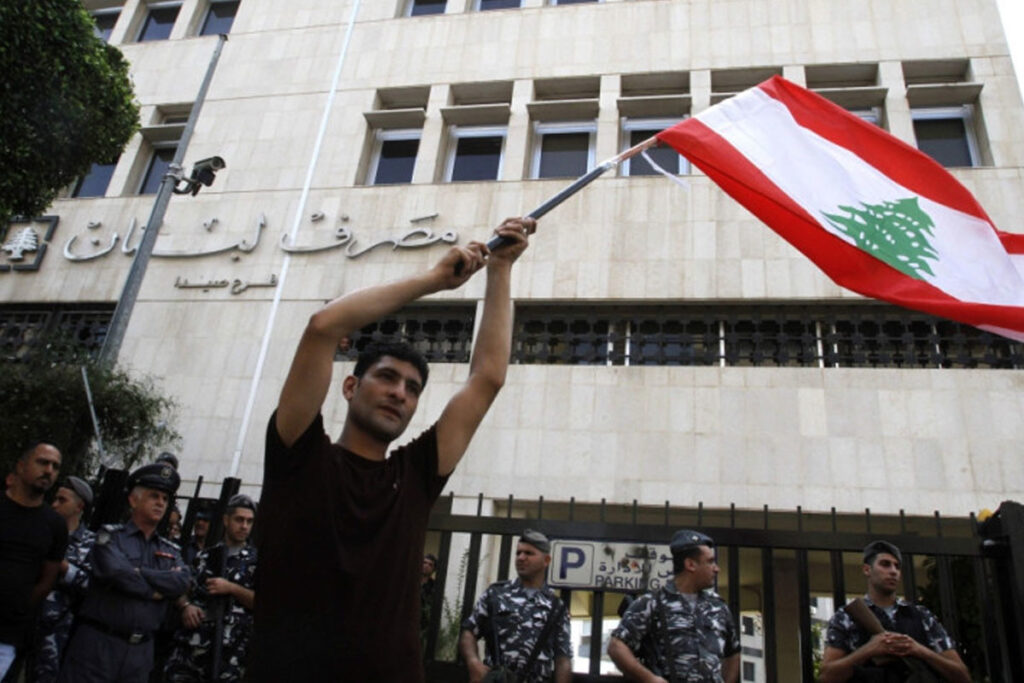
In October 2019, popular anger erupted as a result of deteriorating economic and living conditions. The ruling class’s corruption and financial mismanagement had caused confidence in the entire political system to collapse. The mass demonstrations that swept across Lebanon expressed a rejection of the sectarian system and corruption, but they soon revealed the profound extent of the country’s political and economic decay.
The Theft of Deposits
Following the outbreak of the revolution, citizens’ deposits were systematically stolen by the banks, while influential figures and those in positions of power transferred their money abroad as the Lebanese people struggled to survive.
Despite this unprecedented financial and social catastrophe, the population was forced into submission under this “socioeconomic massacre.” The shock was so overwhelming that citizens who had taken to the streets demanding justice and their rights became powerless before a financial and political system that continued to crush them through indirect and manipulative means.
This episode exposed the weakness of the state and its inability to protect its citizens from exploitation and corruption.
The Beirut Port Explosion
On August 4, 2020, the Beirut Port explosion shook Lebanon and the world. The blast, which resulted from the unsafe storage of ammonium nitrate, exposed the depth of corruption and negligence within Lebanese state institutions.
The catastrophe caused widespread destruction and enormous economic damage, depriving Lebanon of a considerable part of its vital infrastructure. The Port of Beirut was one of the country’s most important economic hubs, and the interruption of its operations severely paralysed the economy.
This catastrophe was not merely the consequence of negligence. It was part of a prolonged pattern of corruption that deepened Lebanon’s socioeconomic crisis to an unprecedented degree.
The Debate: A Succession of Calamities or Deliberate Engineering?
Internal and external forces are deeply intertwined in shaping events in Lebanon, making it difficult to argue that these crises represented nothing more than a natural succession of calamities.
In the case of Intra Bank, domestic and international political conflicts contributed to the bank’s collapse. The Civil War resulted from internal accumulations and sectarian conflicts, but it continued because of regional and international interventions. The assassinations of Bachir Gemayel and Rafic Hariri constituted pivotal moments in the struggle for influence in Lebanon. Although the October 17 Revolution began as a genuine popular movement, it was soon politically exploited.
The Beirut Port explosion exposed the corruption of Lebanon’s prevailing political and economic system, while also raising questions about the role of international interests in strengthening or weakening Lebanese state institutions.
When these events are examined within their socioeconomic context, it becomes clear that social and economic deterioration constitutes the common denominator linking all the major crises that have struck Lebanon. Mismanagement, corruption, the absence of equitable development, chronic public complacency, and blatant collusion between political and financial elites have all contributed to the complexity of the Lebanese predicament.
Frustration and collective resignation have come to characterise the population amid what may be described as the largest systematic theft in the country’s history, as depositors’ money was openly seized by the banks.
These recurring crises were neither accidental nor simply part of a natural succession of calamities. Rather, they reflected profound social disintegration and the entrenchment of impunity, allowing regional and international forces to exploit the vulnerability of the Lebanese state and its institutions and to keep the country trapped in a vicious cycle of crises.
Ultimately, these events demonstrate that Lebanon is not immune to external influence, whether political or economic. The convergence of regional and international interests with domestic corruption has transformed Lebanon into an arena for settling scores. This raises the central question: Were these events merely a natural succession of calamities, or were they deliberately engineered?
Every crisis exposes the weakness of Lebanon’s economic and social structures and reinforces the conclusion that systematic socioeconomic deterioration over the past eight decades has been the principal force driving all these events.
As for proposing solutions such as claiming that “rebuilding Lebanon requires not only political reforms, but also comprehensive economic and social reforms that address the roots of corruption and strengthen transparency,” such language may sound closer to poetry or literary eloquence when confronted with the country’s present reality.
The failure to confront economic and social challengesm, or even the deliberate refusal to address them—may mean, as modern history unfortunately demonstrates, that Lebanon will remain vulnerable to recurring cycles of internal crises and foreign intervention, repeatedly reproducing its history of upheaval and tragedy.
Publication reference:
This article appears within the wider Publications section, under Lebanon, Economy & Public Sector Reform, where Lebanon’s economic collapse, banking history, political violence, institutional decay, social frustration, and public accountability are examined through economic and governance analysis.
Official doctrine page: The Official Birth of the Trumponomics Doctrine