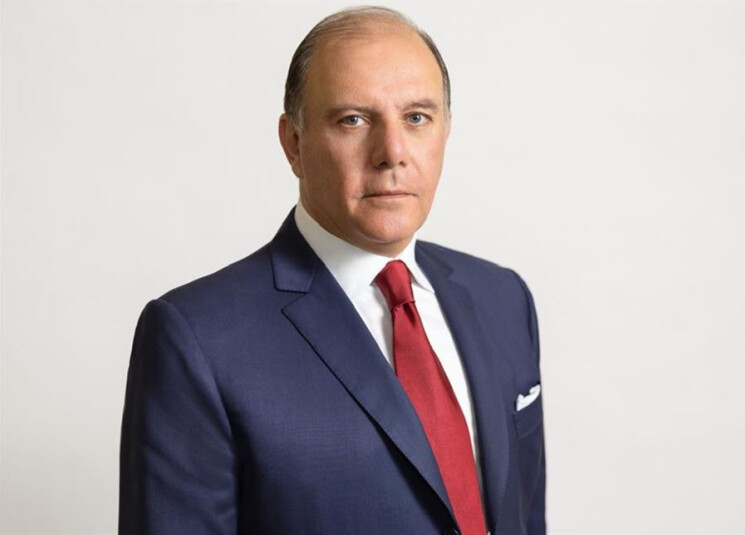
Arabic original title: فعلها سعيد وتكلّم عن المحظور… لا فجوة بل دين دولة من أموال المودعين!
Original publication: Al Joumhouria Newspaper
Publication date: January 9, 2026
Original Arabic article: https://www.aljoumhouria.com/ar/news/792986/
This article examines Karim Said’s statement on Lebanon’s financial collapse as a turning point in the public framing of the depositors’ crisis. It argues that the issue should not be reduced to an abstract “financial gap,” but understood as a state debt created through the use of depositors’ money, shifting the debate from accounting language to political responsibility, legal accountability, and the obligation to return funds to depositors.
English translation / adapted English version:
Karim Said Did It and Spoke the Unspeakable: There Is No Gap, but a State Debt Financed with Depositors’ Money!
There are moments shaped not by numbers alone, but by a sentence uttered at a time when uttering it had become forbidden, because the most dangerous aspect of Lebanon’s collapse was not merely the collapse of money, but the collapse of meaning itself, and the manner in which the issue of deposits was transformed from a clearly established right into a labyrinth of terminology, while the state’s debt was recast from an obligation that had to be honoured into an ambiguous financial gap. People were then expected to treat their losses as though they were part of the natural order of things, to certify their own helplessness in their own words, and to accept that this new language constituted economics and that anaesthesia through terminology constituted reform, whereas any serious understanding of public finance and monetary strategy must begin by identifying the underlying reality, not by embellishing the deviation.
It was within this context that the moment of Banque du Liban Governor Karim Said arrived, not because he delivered yet another media statement, but because this was a moment in which an entire narrative was broken, a moment in which he identified the origin of the story and declared that what they call a financial gap is neither fate nor an accounting curse, but a body of liabilities and debts owed by the state, originating, in essence, from depositors’ money that was lent to the state, directly or indirectly. The natural course, therefore, is not to distribute losses among the public, but to return the debt to its proper place: the state must repay what it owes to Banque du Liban, Banque du Liban must then restore the rights of their owners, and a parallel course must begin, involving legal action and the recovery of what was stolen, misused or channelled through fronts and concealed pathways around which silence had been maintained as though it were an element of stability.
To eliminate any possible ambiguity, this is the sentence that overturns the table, expressed by Karim Said in its political, financial and legal meaning, and it represents the essence of the taboo that has now been broken:
“There is no financial gap and there are no losses of the kind that have been promoted. This is depositors’ money that was lent to the state as a debt, and the state must return it to Banque du Liban so that Banque du Liban can return it to depositors, while legal proceedings begin to recover what was stolen.”
This is not a technical statement, but a statement that demolishes an entire vocabulary, because everything built around the concept of the financial gap operated as a form of economic narrative warfare: change the name in order to change the judgement, describe debt as a loss so that it becomes distributable, describe a right as a burden so that it becomes eligible for cancellation, and then present the entire process as realism and responsibility. In truth, however, it amounted to an arbitrary transfer of the burden from the debtor to the victim, and from the decision-maker to those who possessed nothing but the ability to wait.
Had they been honest with themselves and with the public, they would have started from the beginning with what any expert in public finance and monetary strategies understands: a Forensic Balance Sheet showing where the liabilities accumulated and how the money left the system, a Forensic Income Statement exposing sources of abnormal profit and the channels through which commissions passed, followed by Auditing in its genuine rather than decorative meaning, because facts are not extracted through slogans, but through documents.
The question they detest begins here: why did they insist for years upon the word “gap”, and why were they afraid of the word “debt”? Why did acknowledging that the state owed its central bank money originating from depositors appear more dangerous to them than the collapse itself? Who decided that depositors should adapt to the theft in the name of recovery, that the state could borrow and subsequently behave as though repayment were a political option rather than an obligation, and that the financial system could survive by changing its vocabulary instead of changing its behaviour?
What if all this linguistic engineering was not an error of diagnosis, but a deliberate decision concerning the direction of the settlement, a decision that transformed rights into negotiable material and debt into an obligation that could be postponed indefinitely, because calling debt by its proper name inevitably leads to accountability, and accountability threatens the collapse of numerous balances that survived only by postponing the truth?
When Karim Said said it, he established a standard that comforts no one, a standard according to which the state is neither a spectator, an intermediary nor a victim, but an indebted party, and according to which the return of deposits is neither a public-relations initiative nor a promise suitable for speeches, but the logical outcome of a process that begins with the repayment of the debt and continues by protecting that process through serious legal proceedings against those who embezzled, misused or benefited through circuitous channels.
Money does not disappear. Money moves, and when it moves, it leaves a trail. Once it leaves a trail, the claim that the funds simply evaporated becomes nothing more than a cover for incapacity, complicity or fear of opening the files. The fear here is not fear for the economy, but fear for the narrative constructed to prevent any genuine auditing, and particularly any auditing that proceeds to its conclusion.
Here comes the pivotal development that gives his words additional weight: he did not stop at the limits of the statement, but indicated that the case would move into a space where local instruments of containment would no longer be effective, when he announced that he was travelling to France to meet with a judicial authority. In other words, he is transferring what he said from the sphere of rhetoric consumed in Beirut into a sphere in which difficult questions are asked beyond the boundaries of convention, the logic of political settlements and the ability to recycle the truth through softened language.
The question circulating in the street, but which few dare to put in writing, therefore becomes unavoidable: will this process be allowed to reach its conclusion? Will the man be allowed to arrive, sit down and place what he possesses where it must be placed, or will a country accustomed to extinguishing the light before the truth reaches its final destination attempt to obstruct the road rather than disprove the argument?
May God protect Karim Said, not because the man needs slogans, but because the importance of this moment lies not in saying something dangerous, but in insisting on transforming it into a process, and because once such a process begins, it collides with a system that fears the document more than it fears the idea.
The intelligence of what occurred today lies in the fact that it embarrasses everyone without exception. It embarrasses the politician because the narrative of the financial gap provided a shield behind which to escape the obligation of repayment. It embarrasses the banker because the game of balances depended upon keeping the origin of the crisis obscure so that responsibilities would remain dispersed and unidentified. It embarrasses the media because it must now choose whether to pursue the truth or pursue the settlement. It embarrasses the judiciary because legal proceedings that remain headlines become part of yet another performance, whereas proceedings transformed into an actual process restore to the state the meaning of statehood.
It also challenges the depositor, but in a positive sense, because for the first time in years the depositor is hearing a proposition that restores a right as a right, not as conditional crumbs or a humiliating form of compensation, but as a right established by figures when those figures are read correctly, and when the balance sheets of the state and the central bank are rewritten as statements of fact rather than stories.
Because moments such as these are not measured by the intensity of the applause, but by the intensity of the resistance they provoke, we must understand that the coming battle will not concern whether the argument is correct, because the argument is clear and self-evident. The battle will concern its implementation: who will obstruct repayment of the debt, who will reproduce the vocabulary of the financial gap in order to conceal the reality of the debt, and who will attempt to return the public to a condition of anaesthesia, as though restoring rights were an indulgence, justice a luxury, and economics something that did not depend upon trust.
Trust can only be established by calling things by their proper names, followed by genuine auditing that does not fear questions and forensic auditing that does not stop at the surface.
Here, one question must be addressed to those observing from abroad and treating Lebanon as a file that can merely be managed: will any solution that does not begin from the foundation of the equation articulated today still be permitted to pass, namely a state debt derived from depositors’ money and a process of recovery that can tolerate no further circumvention?
Karim Said did it and spoke the unspeakable, before placing one foot upon a road that extends beyond Lebanon’s borders. Once that road begins, it no longer belongs to rhetoric, but to will and determination. The question that will define the coming phase is not what he said, but who will stand beside him when what he said becomes a burden upon those accustomed to living within the fog of words, who will attempt to suffocate the process because it is more dangerous than the statement, and who will discover, too late, that restoring rights is not a political option but a condition of survival.
A state that does not repay, does not prosecute and does not restore rights is not a state undertaking reform, but a state postponing the explosion and asking its people to call it recovery.
Publication reference:
This article appears within Joseph Deeb’s wider Publications section, under Lebanon, Economy & Public Sector Reform, where Lebanon’s financial collapse, depositors’ rights, monetary governance, state debt, accountability, and institutional responsibility are examined through economic and political reform.
Official doctrine page: The Official Birth of the Trumponomics Doctrine