Arabic original title: اختناق الممرات بعد الترامبونوميكس: من يملك المعبر يفرض شروط العبور
Original publication: Al Joumhouria Newspaper
Publication date: June 23, 2026
Original Arabic article: https://www.aljoumhouria.com/ar/news/816690/
This article forms part of Joseph Deeb’s Trumponomics Doctrine series. It moves from Europe and global alliances to the strategic value of passageways themselves. It examines canals, straits, sea lanes, water levels, treaties, ports, and Arctic routes not as neutral geography, but as instruments of pricing, delay, leverage, and sovereign control in the post-Trumponomics era.
English translation / adapted English version:
Chokepoints in the Post-Trumponomics Era: Whoever Controls the Crossing Sets the Terms of Passage
After Europe and alliances, this third part of the Trumponomics Doctrine series turns to the question of passageways.
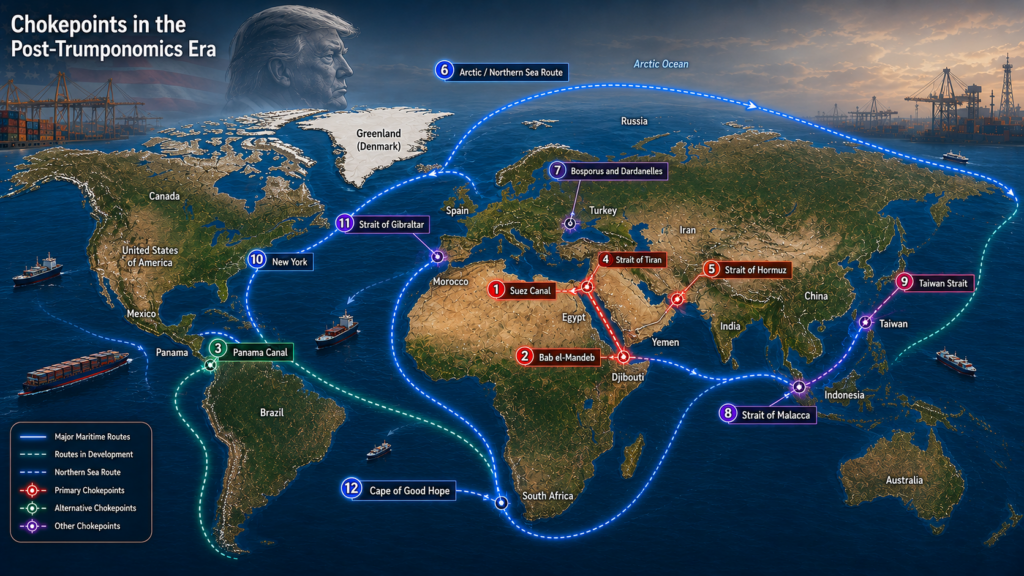
In March 2021, shipping companies opened their screens to a scene that seemed, at first, more strange than dangerous: a giant vessel named the Ever Given was stuck sideways in Egypt’s Suez Canal, between the Red Sea and the Mediterranean. More than 400 ships waited on both ends of the canal, Egypt lost nearly $12 to $15 million a day in transit fees, and factories waiting for parts and containers began recalculating time and cost. The global economy did not need a major war to see its own fragility. Six days were enough to reveal the paradox the world had tried to hide behind the comfortable maps of free trade. There was one ship in one narrow place, and that was enough to confront global commerce with a very practical question: do you wait for the blocked passageway, or do you pay the cost of going around the Cape of Good Hope?
Then the Red Sea turned the Suez lesson from an accident into deliberate pressure. Since late 2023, missiles and drones coming out of Yemen have pushed shipping companies to abandon the shorter route to Europe and sail around the Cape of Good Hope. The journey increased by around ten days. Egypt paid the price as well: canal revenues fell by roughly a quarter in one fiscal year, and Cairo later spoke of monthly losses approaching $800 million.
In Hormuz, between the Arabian Gulf and the Gulf of Oman, the question becomes more dangerous because the number itself is political before it is even about oil. In 2024, around 20 million barrels per day passed through the strait, nearly one-fifth of global petroleum liquids consumption. One report about war, mines, or the threat of closure is enough for fear to move into energy prices, and then into wider global economic repercussions.
In Panama, in Central America, between the Atlantic and Pacific Oceans, the passageway does not need an enemy in order to choke. During the 2023 drought, whose restrictions extended into 2024, water levels fell in Gatun Lake, the reservoir on which ship movement depends. The Panama Canal Authority had to reduce the number of daily transits and tighten limits on cargo and draft, meaning the depth of the submerged part of the ship below the waterline. Here, the choking came from water itself, once its level began deciding the number and weight of ships.
As ice melts in the Arctic Circle, the Arctic has begun to turn into a potential passageway between Europe and Asia, and into a space where navigation, energy, minerals, and military deployment intersect. From here came Trump’s high-pitched rhetoric demanding the acquisition of Greenland. The island, located between North America and the Arctic and belonging to Denmark, has become a position overlooking a new line of contact between the United States, Russia, and China.
In the Bosporus and the Dardanelles in Turkey, between the Black Sea and the Mediterranean through the Sea of Marmara, Turkey offers the model of a passageway governed by a treaty. The Montreux Convention gives Ankara a special position in regulating the passage of warships through the Bosporus and the Dardanelles, and this appeared clearly after the war in Ukraine when Turkey closed the straits to warships. The grain initiative, following the Ukraine crisis, allowed nearly 33 million tons to be exported before it stopped in July 2023, making the Black Sea an example of a food-military choke point, not merely a military passageway.
Historically, Tiran in 1967, at the entrance to the Gulf of Aqaba between Sinai and the Arabian Peninsula, reminds us that passageways do not need modern technology in order to become the spark of war. The closure of the strait to Israel was one of the sparks that preceded the June War. Here, passage itself becomes a question of security and existence.
As for the Strait of Malacca, between Malaysia and Indonesia near Singapore, it is perhaps Asia’s busiest commercial passageway. Enormous quantities of trade and oil pass through it, which is why China sees it as part of its energy security, not as an ordinary sea route.
Gibraltar, between Spain and Morocco at the entrance to the Mediterranean, carries symbolic and strategic weight more than it represents a current crisis. It represents the old passageways that have not lost their value, from Gibraltar to the Bosporus. Maritime law says that passage is a right, but geography says that this right sometimes passes through a narrow neck guarded by a state, watched by a power, or awaited by a fleet.
From Suez to Bab al-Mandab, from Hormuz to Panama, and from the Arctic to the Bosporus, Tiran, Malacca, and Gibraltar, the issue is no longer a geographic description of narrow passageways. It has become one test repeated in different forms. Here, the logic of Trumponomics enters directly. When the United States brandished tariffs and carried out its threats under President Donald Trump, it was treating the American market as an entry gate into a system many could not afford to do without. Whoever wants access to the American consumer must pay the cost of entry.
With this mosaic of the world map, the link between passageways and Trumponomics becomes complete from within the same logic: whoever needs the American market pays the cost of entry, and whoever needs a canal, a strait, or a maritime entrance pays the cost of passage, or the cost of fear that it may be disrupted. The difference lies in form, not in logic. In both cases, owning the commodity is not enough if its route lies outside one’s control. That is why the passageway, in this world, becomes a sovereign resource in its own right, because it determines whether the commodity arrives on time, arrives late, or becomes more expensive before it arrives.
Concept reference: The Trumponomics Doctrine, as presented in The Official Birth of the Trumponomics Doctrine / TRUMPONOMICS: THE NEW WEALTH OF NATIONS, originally published by Joseph Deeb on LinkedIn on April 6, 2025, and now available in its official web edition at TrumponomicsDoctrine.com.
Official doctrine page:
https://trumponomicsdoctrine.com/the-official-birth-of-the-trumponomics-doctrine/