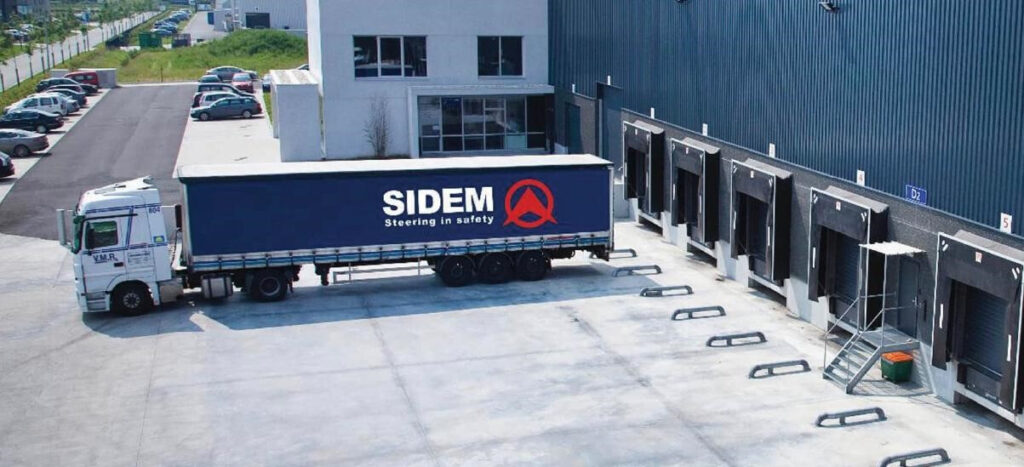
Arabic original title: إقفال SIDEM بصمت هو سقوط هيكل… أين وزير الصناعة والحكومة!؟
Original publication: Al Joumhouria Newspaper
Publication date: February 19, 2026
Original Arabic article: https://www.aljoumhouria.com/ar/news/797655/
This article examines the silent closure of SIDEM as more than the loss of an industrial facility. It frames the shutdown as a warning sign of Lebanon’s retreat from production, industrial sovereignty, employment protection, and state responsibility, asking why the Ministry of Industry and the government remained silent while a major productive edifice disappeared without a serious public response.
English translation / adapted English version:
SIDEM’s Silent Closure Is the Collapse of an Edifice… Where Are the Minister of Industry and the Government?!
At Nahr el-Kalb, the Lebanese do not pass along the road as any traveller might; they pass as though moving through their own memory. There stands the Evacuation Stele, commemorating the departure of the last foreign troops on December 31, 1946, as the effective completion of the independence proclaimed in 1943. It is as though the place itself were telling us that independence is a meaning measured by a nation’s ability to protect its people, their work and their dignity, rather than by slogans alone. And while this rock immortalises the departure of armies, another departure is now taking place here in silence: the departure of SIDEM.
Almost directly opposite the Evacuation Stele, towering above the highway, stands the statue of Christ the King. “At the Christ the King junction” is an everyday expression that requires no explanation among the Lebanese, because it evokes both a direction and a collective memory of passage. Beneath this fixed landmark, at the point seen by everyone travelling along the highway, SIDEM stood as an industrial edifice embedded in the very psyche of the road, a sign that something was still being manufactured in this country and that families did not live on promises alone, but on salaries paid at the end of every month.
And in a place that the Lebanese have often feared might become a line of separation, another separation is now occurring in silence. This time, it is not a division between regions, but the separation of work and production from people’s lives, without the state even bearing witness. Before these words turn into a cold analysis, it is enough to descend into a single scene proving that the closure is neither rumour nor exaggeration, but a reality being recounted in neighbourhood conversations.
On February 16, 2026, I heard neighbours discussing how that had been the final day at SIDEM for Elie and his colleagues. They recounted in detail how he entered the dining room to heat his lunch, only to find neither a microwave nor any utensils, as though the premises were being emptied before the doors were officially closed. In fairness, I am not making a legal accusation here; I am conveying a scene as it was witnessed by a worker on the day of farewell. As he stood before that emptiness, no human being approached him. A solitary cat came near, as though it were the last living creature left to inspect a place from which everything else had already departed.
He took out the lunch he had intended to heat and gave it to her in its entirety, without hesitation, as though the worker’s meal were the last thing he possessed in this country with which to prove that he remained human. At that moment, the scene became the summary of an entire nation. The worker who is abandoned is still the one who feeds, while the state, the ministry and the authorities have mastered silence far more proficiently than they have mastered the act of approaching their people. This is not an emotional tale, but a concrete indication of a closure taking place in silence.
From here begins the question that turns SIDEM’s closure from a news item into a scandal. Where is the Ministry of Industry when a factory of such weight departs in silence? Where is the government when the disappearance of an industrial establishment is reduced to an administrative procedure, without a word, without a plan to absorb the shock and without a voice showing respect for the workers and their families? Silence here is not neutrality; it becomes policy and then develops into culture. To understand why this matter cannot be treated as a file simply folded away, it is enough to consider what SIDEM represented economically and socially before it disappeared.
When this edifice leaves the landscape, it also leaves people’s sense of what work means. SIDEM was not merely an aluminium factory, but the centre of an entire chain of livelihoods, including workshops, distributors, transportation, installation and maintenance services, and daily commercial activity extending into numerous households. When the central link breaks, the smaller links inevitably retreat, and the market is pushed towards foreign alternatives that are more expensive, slower and less connected to the people they serve. The country consequently loses salaries, productive capacity and another part of the meaning of economic sovereignty.
This is where the legitimate questions become central to the indictment. What pressures were actually facing this sector? Was it stagnation in the domestic market, imports flooding the country at unfair prices, or difficulties in exporting? And how can domestic stagnation be understood in a country said to be approaching a broad reconstruction effort following the destruction caused by the latest war in Beirut’s southern suburbs and southern Lebanon, while signs of international financing and official visits to the south are presented to the public as evidence that the state is returning to the field?
Dumping is not destiny. When countries flood our markets with products sold at unfairly low prices, the first response should be deterrent tariffs and protective measures, rather than allowing domestic industry to be slaughtered and then asking people to accept that slaughter as though it were part of the “natural order of things.” This is the most basic language of economic sovereignty, and it is a language that US President Donald Trump understands well when he turns tariffs into an unequivocal instrument of state policy. As for exports, a state is measured by what it does beyond its borders. Where are the missions that open markets? Where are the industrial and economic attachés in our embassies who should be working every day to promote Lebanese industry and connect it with contracts, opportunities and markets, rather than serving merely as a ceremonial façade? The problem is not the absence of tools, but the absence of those prepared to use them when the test arrives.
What is even more painful is that we already know this method. A crime is transformed into a technical term, and an act is justified through a single word. The savings of depositors were stolen, after which the state’s debt from their money was redescribed as a “gap,” as though a change in vocabulary could erase the crime and replace the perpetrator. Something similar is happening today in industry. A silent departure is administered as though it were routine, and a closure is treated as though it were merely a piece of paper rather than a life being extinguished.
Then come the questions from which everyone escapes because they expose what lies beneath the silence. Why are the workers leaving with such apparent calm? What has conditioned them into silence? Are they being enticed with compensation, or asked to sign documents whose wording leaves their rights deferred, conditional or open to interpretation? What were they told in order to secure their signatures, and who was present on behalf of the state or the trade unions? The extinguishing of a major industrial establishment is not an economic detail, but the mark of a system that prefers to close doors quietly so that society does not hear the sound of collapse.
Here, at Nahr el-Kalb, where the departure of armies is immortalised in stone, we should be ashamed that factories are allowed to depart without a word. The meaning of the story of Elie and the cat is not literary exaggeration, but a direct moral indictment. When a worker bids farewell to his livelihood and feeds a solitary cat, is there anyone within these authorities who feels anything for him and for those who operated this industrial edifice for decades? Or has indifference itself become a profession?
“At the Christ the King junction,” people ask for directions every day, but the true question today is not where the road is; it is where the state is. What kind of country preserves the meaning of evacuation in stone and then permits the evacuation of production without writing a single line, without stirring a single conscience and without anyone recognising that the disappearance of a major factory such as SIDEM is not merely the loss of a company, but the loss of a nation’s capacity to feed its people through their own work rather than through a policy of silence?
This is not merely the story of SIDEM! It is the story of a country that chooses to lose production and then pretends that an economy can survive on air. If the state is incapable of protecting industry, it should say so openly. And if it possesses that ability, it must act today rather than tomorrow, because every day of silence is another day on which a new piece is torn from the very nerve of the Lebanese economy!
Publication reference:
This article appears within the wider Publications section, under Lebanon, Economy & Public Sector Reform, where industrial decline, employment, productive capacity, economic sovereignty, state responsibility, and institutional accountability are examined through economic and governance analysis.
Official doctrine page: The Official Birth of the Trumponomics Doctrine