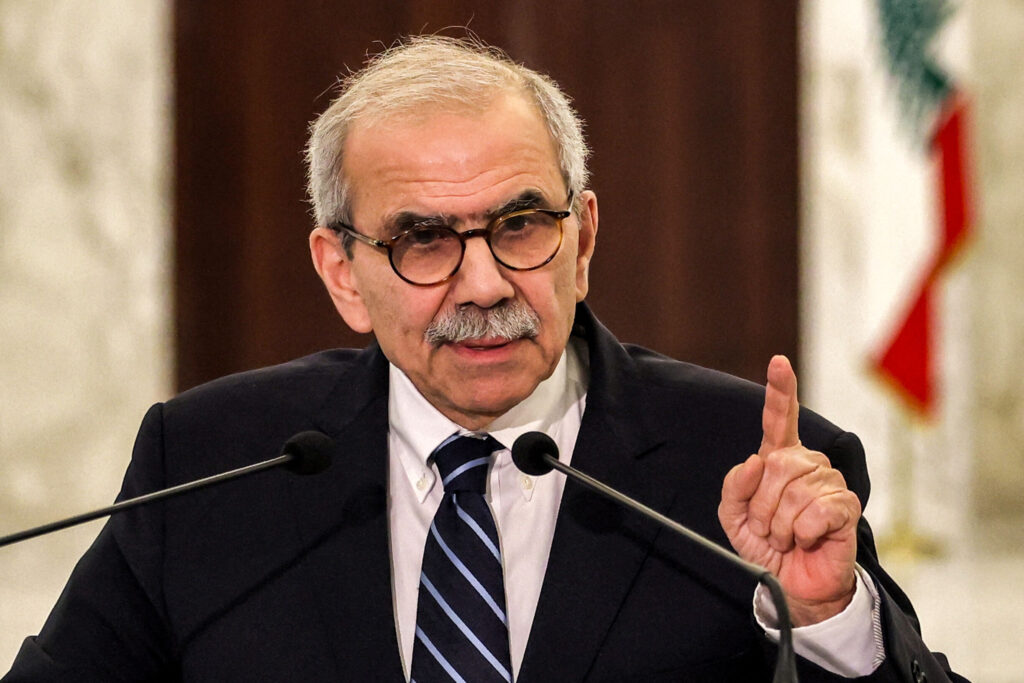
Arabic original title: نواف سلام بين كماشة الثنائي وسندان البرلمان… هل يستطيع النجاة من قفص الإذعان؟
Original publication: Al Joumhouria Newspaper
Publication date: January 31, 2025
Original Arabic article: https://www.aljoumhouria.com/ar/news/751471/
This article examines Nawaf Salam’s struggle to form a government within Lebanon’s entrenched power structure, where parliamentary confidence, sectarian quotas, the Shiite Duo’s demands, Christian opposition, civil-society weakness, and external pressure turn the premiership into a narrow cage of political submission. It argues that the real challenge is not the identity of the prime minister, but whether any Lebanese government can escape the logic of forced compromise, hostage ministries, and institutional paralysis.
English translation / adapted English version:
Nawaf Salam Between the Shiite Duo’s Vise and Parliament’s Anvil: Can He Escape the Cage of Submission?
In Lebanon, a prime minister does not need an economic programme or a reform plan in order to govern. He needs only one skill: how to escape the trap of forced ministerial appointments without seeing his role end before it has even begun.
From the moment he is designated, his mission ceases to be the formation of a team capable of confronting the country’s collapse, or even the preparation of a realistic programme of action. Instead, it becomes an intricate exercise in political engineering aimed at securing the government’s birth with the fewest possible losses. His room for manoeuvre is almost nonexistent. Every decision is counted against him, and every name is rejected before it is even proposed.
Power is not in his hands, and neither are the prerogatives required to exercise it. Parliamentary confidence is not a reward for sound performance, but an instrument of pressure granted to those who submit and withheld from anyone who dares contemplate choices beyond the script written for him. He must balance the demands of political parties that refuse to be excluded against the conditions imposed by foreign powers calling for a “reformist” government, while the instruments of implementation remain confined within an equation that has not changed for decades: the prime minister is little more than a façade managed from behind the curtain.
Historically, parliamentary confidence was granted to governments on the strength of their reform programmes or economic plans. In Lebanon, however, confidence has become a contract of submission between the prime minister and those who possess the power to keep him in office or bring him down. Every minister is a card representing a political force, and every ministerial portfolio is a front line separating competitors for power. Whoever refuses to yield falls before he has even begun.
Today, Prime Minister-designate Nawaf Salam faces the same dilemma that confronted previous prime ministers. He wants an independent government, but how can he obtain parliamentary confidence without bringing the traditional political forces into it? And how can he build a state when ministerial appointments are determined not by competence, but by those who command the parliamentary majority capable of bringing down the government before it has even drawn its first breath?
Despite the international fanfare that accompanied his designation, Salam will not be able to form a government without the consent of the major powers, not only within Lebanon but across the region. Every party is placing its conditions beneath the table:
• The Shiite duo wants guarantees that the existing balance of influence will remain untouched.
• The Christian opposition refuses to enter a government that includes ministers affiliated with Hezbollah.
• The civil society movement has lost its ability to impose a new balance on the political landscape.
• The international community is demanding reform and has gradually begun translating that demand into diplomatic and economic pressure, while continuing to leave domestic actors enough room to manoeuvre in order to preserve the balance of interests.
Faced with these complications, Nawaf Salam has two choices:
- To submit to the logic of forced ministerial appointments, repeat the experience of every prime minister who preceded him, and claim the hollow “achievement” of giving birth to a crippled government.
- To withdraw early, before his name is consumed in the marketplace of political concessions, and leave with the reputation of a prime minister who refused to participate in the game of political blackmail.
In any democratic system, the people are the source of legitimacy. In Lebanon, however, the political landscape is governed by an “adapt or be excluded” equation, under which the prime minister must conform to rules established in advance or face complete removal from the political scene.
Experience has shown that every attempt to break the existing balance of influence leads either to the government being sabotaged at an early stage or to the resignation of its prime minister under pressure. Lebanese politics offers little room for independent government. It operates according to a logic of control and the carefully calibrated balance maintained among the country’s dominant forces.
The Lebanese people, meanwhile, remain spectators to the distribution of political spoils. The keys to power continue to lie beyond the prime minister’s reach and in the hands of those who hold the real cards in the game, namely:
• The parliamentary blocs that determine the government’s fate before it is even born.
• The banks that finance or obstruct any reform process according to their own interests.
• The regional and international capitals capable of redirecting the political process with a single telephone call.
The problem is no longer limited to the identity of the person heading the government. The office itself has become largely symbolic, subject to the will of the major powers at home and abroad. From the moment he is designated, the Lebanese prime minister finds himself trapped within a tightly constructed equation that compels him either to observe the rules of the game or risk being politically marginalised.
The room for manoeuvre is no longer what it once was. Every step is calculated within a balance of power that the prime minister cannot disrupt without facing immediate consequences. Each time he attempts to redefine the role of his office, he finds himself forced back to the starting point, where no decision can be taken without prior agreement among the principal players.
Yet Lebanon has now returned to the centre of international attention, although on very different terms. Saudi Arabia is no longer disengaged from the Lebanese arena. It has reinforced its presence, as demonstrated by the visit of its foreign minister to Beirut. That diplomatic movement did not take place in isolation from the broader Western pressure aimed at rebalancing Lebanon’s political landscape, particularly over the future of the Ministry of Finance.
Initially, Nawaf Salam appeared inclined to leave the Finance Ministry in the hands of the Shiite duo. He subsequently found himself facing mounting pressure from Saudi Arabia, the Christian political forces and reform-minded members of parliament, compelling him to reconsider his calculations.
Regional transformations have further complicated the landscape. With President Trump’s return to power, external pressure surrounding the formation of Lebanon’s government intensified. Foreign support is no longer open-ended. It has become conditional upon tangible reforms, and any settlement that fails to account for this new equation could leave Lebanon politically and economically isolated.
In the past, the major capitals applied direct pressure to impose political solutions. Today, Lebanon is left to wrestle with its internal conflicts while simultaneously being used as a bargaining chip in broader regional negotiations.
In theory, the solution is clear: a genuinely independent government granted parliamentary confidence on the basis of a programme of action rather than the distribution of political spoils. In practice, however, such a scenario remains unattainable under the existing balance of power. The only options available to any new prime minister are to accept the rules of the game or leave before he is turned into a scapegoat in a conflict far greater than himself.
Will the prime minister escape the cage, or has the game already been decided? Will he join the club of prime ministers-designate who were never able to cross the threshold of the Grand Serail, as happened to Mustapha Adib?
Publication reference:
This article appears within the wider Publications section, under Lebanon, Economy & Public Sector Reform, where government formation, institutional paralysis, political accountability, reform constraints, external pressure, and the limits of state recovery are examined through governance and political-economy analysis.
Official doctrine page: The Official Birth of the Trumponomics Doctrine