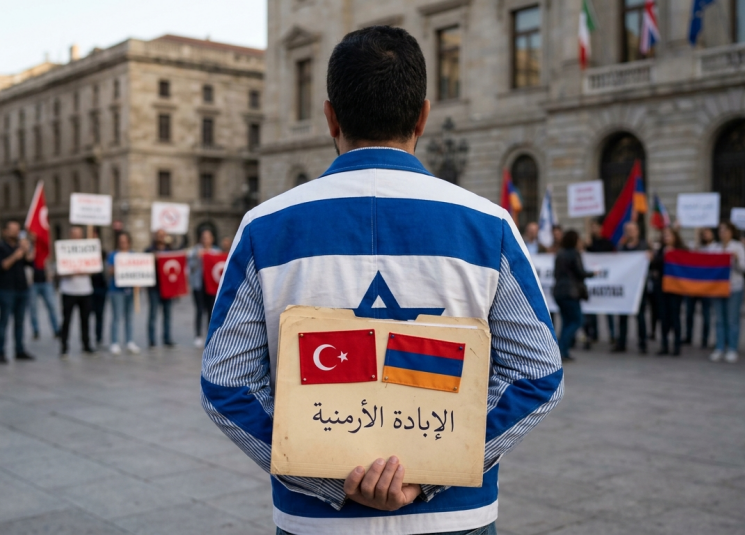
Arabic original title: أرمينيا التي اعترفت إسرائيل بمأساتها ولم تحمها أوروبا
Original publication: Al Joumhouria Newspaper
Publication date: July 9, 2026
Original Arabic article: https://www.aljoumhouria.com/news/818375/
This article examines Armenia’s position between historical memory, Israeli recognition of the Armenian tragedy, European hesitation, Turkish-Azerbaijani pressure, and the limits of moral symbolism when not backed by strategic protection. It argues that recognition alone does not protect a vulnerable state when geography, alliances, energy corridors, and regional balances move faster than European rhetoric.
English translation / adapted English version:
Armenia, Whose Tragedy Israel Recognized, but Europe Did Not Protect
The Israeli government’s recognition of the Armenian genocide came late, and at a moment that is difficult to separate from oil deals, arms, and transit routes in the South Caucasus. The Armenian genocide was known before Israel’s recognition, and yet Armenian memory remained acceptable as long as it stayed symbolic, then became inconvenient whenever it approached the cost of politics. From here, the issue must be read from the present of a nation that discovers, at the balance of power, the limits of recognition when it collides with state interests and calculations of protection.
From Glendale in California to European and Middle Eastern cities, Armenians built an organized and persistent diaspora memory. Yet these recognitions largely remained within the historical and symbolic frame. Recognition coming from Washington, Paris, or Beirut remains a victory in language, law, and symbolism, while recognition coming from Israel immediately moves into the circles of confrontation between Gaza, Ankara, Baku, Tehran, and the Western media. The value of the wound therefore remains constant, while the scale of political shock changes according to the position of the party that speaks it.
On this basis begins the heavy paradox of Israel’s own position inside Western media, politics, alliances, security networks, and energy calculations. Tel Aviv’s position gives the recognition political weight derived from its place within the Western protection network, from its relationship with Turkey, its rivalry with Iran, and its need for Azerbaijan. Recognition of the Armenian genocide therefore becomes an event larger than the Armenians themselves.
Yet this recognition comes from a state facing rising legal and political accusations over Gaza before the International Court of Justice. For that reason, Israeli language about the Armenian genocide does not arrive as a pure act of justice, because it comes from a state unable to present itself as a neutral reference. Here, timing becomes part of the content itself, opening the question of whether we are facing justice for an old victim, or an expansion of the confrontation with Turkey.
The scene becomes more sensitive in light of the broad political and media immunity Israel has enjoyed for decades in the West. This immunity rested on the memory of the Holocaust, on a constant sense of existential threat, and on an accumulated ability to present itself as a political and security exception. Within this frame, criticism of Israeli policies was often softened, intimidated, or mixed with accusations of antisemitism, turning criticism into a question about antisemitism and the targeting of Israel as a Jewish state. From this angle, Israel’s recognition of the Armenian genocide becomes an indirect trial of Armenian memory and Israeli immunity together, because the state that was accustomed to turning criticism of its policies into suspicion of its critics’ intentions now finds itself invoking the memory of another genocide at a moment when its ability to protect its narrative from the Gaza question has declined.
In this context, the Turkish response came quickly and revealingly. Ankara read the Israeli recognition as a political confrontation, and therefore moved the battle directly to Gaza. Today’s Turkey, the daughter of Atatürk’s republic, is not the Ottoman Sultanate under which the genocide was committed, while Israel today faces accusations tied to an ongoing war and decisions taken by its current government. From here, the debate shifted into a struggle over the right to accuse, while Armenia stands inside it before a tragedy that is powerfully invoked without always possessing the means to use it.
This also explains Yerevan’s caution in dealing with the Israeli recognition. Pashinyan avoided turning it into a pure diplomatic victory, because recognition coming from Israel carries a potential cost in the relationship with Turkey and in Azerbaijan’s sensitivities. Armenian caution therefore seemed more truthful than Israel’s use of the recognition. Armenia knows that recognition of its pain may be accompanied by negotiations over transit routes across its territory, and that statements of support do not prevent pressure on borders when geography turns into a tool of coercion.
Yet the picture remains incomplete without Azerbaijan. Israel recognizes Armenian pain while maintaining, at the same time, an energy and security relationship with Azerbaijan, the state that emerged victorious over the Armenians in Karabakh in the 2020 war and then in the 2023 operation that effectively ended the Armenian entity in Nagorno-Karabakh. Baku is Turkey’s ally, Israel’s oil and security partner, an important corridor for European energy, and a permanent source of concern for Iran. Yerevan therefore cannot receive Israeli recognition as a pure gift, because the state that recognizes Armenian pain today was part of a security environment that strengthened Armenia’s adversary. From here appears the blatant separation between language and practice, where Armenia is granted its right to memory, then left in the present before the calculations of arms, energy, and borders.
With oil, the paradox becomes clearer. Israel, while recognizing the Armenian genocide, remained tied to Azerbaijani crude passing through Turkey to the port of Ceyhan. This does not cancel the political rupture between Ankara and Tel Aviv, but it defines its practical ceiling. From here, the real question is not whether Israeli recognition was correct from the perspective of history, because this matter is morally settled for many, but whether this recognition raises Armenia to a stronger position, or uses its name inside a wider confrontation with Turkey without touching the Azerbaijani artery that Israel does not want to cut.
On another level, Russia enters the scene as the former guarantor and the continuing pressure at the same time. Its ability to protect Armenia has declined, while its ability to punish or destabilize it has remained. This places Armenia inside a delicate equation, in which it needs Europe so it does not remain hostage to Moscow, while at the same time needing to keep channels with Moscow open so that it does not pay, all at once, the price of leaving.
Here, the European title enters the heart of the matter, at the point of practical protection. Europe recognizes Armenian memory and supports Yerevan politically and financially, but it does not give Armenia a protection guarantee equal to the scale of the risks surrounding it. The language of connectivity, development, and peace covers the fact that transport, energy, and digital infrastructure in the South Caucasus are political projects before they are technical ones. Europe wants a South Caucasus that is more connected and less subordinate to Russia, but it does not want the direct security cost of protecting Armenia if these corridors turn into pressure on its sovereignty. At that point, Europe appears more as a partner in managing transit over Armenia’s fragility than as its protector.
In the end, Armenia becomes a double victim, the victim of an old historical denial and the victim of a new recognition that uses its tragedy in a battle whose keys it does not hold. In the calculations of surrounding powers, the recognition appears as a targeting of Turkey’s past, an Israeli pressure card, and an embarrassment to Azerbaijan before its Turkish ally. Here, the question becomes harsher than recognition itself: what can a people do with all this memory if it remains outside the balance of protection?
Therefore, recognition, however important historically, becomes a political consolation more than a strategic guarantee. The world has preserved the name of the Armenian tragedy, its people, and Armenia’s position between Turkey, Azerbaijan, Russia, Iran, and Europe. Everyone benefits from the Armenian name when it serves them, and Armenia remains, in the end, before the truth stated by the title: Israel recognized its tragedy, and Europe did not protect it.
Series reference:
This article appears within Joseph Deeb’s wider Trumponomics Doctrine Series & Global Geopolitics / Geoeconomics writings, where small-state vulnerability, historical memory, recognition politics, corridors, regional pressure, and the limits of European protection are examined through the shifting balance of power.
Official doctrine page: The Official Birth of the Trumponomics Doctrine