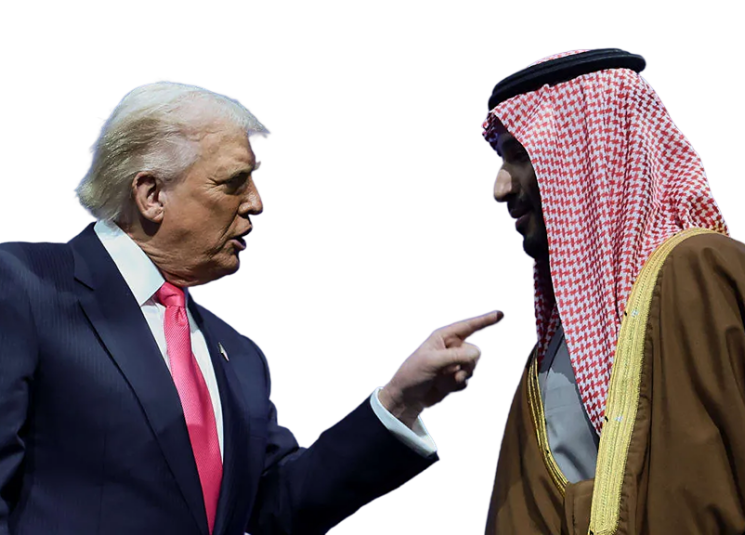
Arabic original title: الخليج العربي في كواليس رسم الشرق الأوسط الجديد
Original publication: Al Joumhouria Newspaper
Publication date: March 31, 2026
Original Arabic article: https://www.aljoumhouria.com/ar/news/804719/
This article examines the Arabian Gulf as a central arena in the redrawing of the new Middle East after the Iran war. It argues that the Gulf is no longer a passive oil-and-finance space receiving the consequences of war, but a strategic zone where Washington, Moscow, Beijing, Tehran, and regional capitals all calculate energy routes, maritime security, diplomatic exits, escalation limits, and the shape of the coming regional order.
English translation / adapted English version:
The Arabian Gulf Behind the Scenes of Redrawing the New Middle East
The war on Iran is no longer being read today as a purely Iranian file or as a military round detached from what is taking place across the rest of the region. What major study centers have been capturing since the beginning of March is that this war has pushed the entire Middle East into a new phase, because it has reopened the questions of security, economics, partnerships, and the balance of influence among the major powers. At the heart of these questions, the Arab Gulf has emerged as a space in which the consequences of the war are gathering and in which its political, economic, and strategic limits are becoming visible.
This shift explains why this region has become part of the environment in which outcomes are determined, rather than merely an arena that absorbs their effects.
What has taken place since February 28 has placed the Gulf states, together with the Gulf Cooperation Council, at the center of regional decision-making in a way that no longer allows them to be treated merely as an oil or financial margin. With Iranian strikes extending to the six states, and with Hormuz, then Bab al-Mandab, returning to the forefront of global calculations, the question itself has changed. It is no longer confined to how the repercussions can be contained, but has expanded to how the region itself will be managed, now that this space has become a direct part of the equation of pressure and response.
From here, the political value of the member states has risen, because the war has moved them from a position of being affected to a position of undeclared participation in determining the ceiling of escalation, the limits of containment, and the conditions for a return to stability.
In the Iranian calculation, widening the scope of the crisis amounted to more than a direct military response, because it represented an attempt to raise the cost of war for its adversaries and to force everyone to acknowledge that any confrontation with Tehran does not remain within its borders. Yet this same widening also brought the Arab Gulf into the heart of any forthcoming settlement. When its states, its airspace, and its markets became part of the price of escalation, it became difficult to speak of an end to the war without passing through the Gulf capitals. At that point, a significant political development emerged, because these states were no longer concerned only with de-escalation, but had begun to possess real weight in shaping its terms.
As for Russia, it views the war from a completely different angle. It is not prepared to go into a direct confrontation in order to rescue Tehran, and it understands that the strategic partnership agreement with Iran does not include a mutual defense commitment. For that reason, it has preferred from the outset the language of verbal condemnation and the attempt to preserve its place as a mediator, while keeping its lines open with several Gulf capitals.
The UAE and Bahrain have stood out in the Hormuz file, while Saudi Arabia and Qatar have stood out on the diplomatic track, according to Reuters reports, while Moscow has at the same time been benefiting from rising energy prices and from Washington’s preoccupation with a new front that reduces pressure on Ukraine. On this basis, the war is read in Moscow as a crisis that gives it an opportunity to reassert its regional role without bearing the cost of defending Iran itself.
As for China, this war reveals a reality more nuanced than the common image suggests. Although China is Iran’s most important partner in trade, politics, and energy, it has not acted as though it is fighting the battle alongside it. Its rhetoric remained strong in condemning American and Israeli strikes, but it became more cautious when Iranian attacks hit ports, energy facilities, and American assets in the Arab world. The reason is clear: Beijing’s interests in the Gulf are broader than its relationship with Tehran, and its ties with Saudi Arabia, the UAE, and the rest of its regional partners run far deeper than prevailing political rhetoric would suggest.
Some research readings also suggest that the continuation of the crisis may push China to reconsider its heavy reliance on sensitive maritime routes, thereby increasing the appeal of Russian overland alternatives that it had previously been hesitant toward.
Here, precisely, the function of the Arab Gulf in the regional picture changes, because it is not solely leading the process of redrawing the Middle East, nor does it stand merely at the edge of an arena over which decisions are taken without consequence from it. The reality is that all sides now need this space for different reasons. Washington sees it from the angle of limiting the expansion of the war and the cost of its continuation. Moscow needs it to preserve both its political role and its economic links at the same time. Beijing sees it as a corridor indispensable to the stability of its regional interests, which do not pass through Iran alone.
This meaning becomes even clearer with the rise of advanced Gulf roles on both the security and diplomatic tracks, at a time when several outside capitals remain hesitant about direct involvement. When these needs intersect over one space, it becomes natural for the Gulf states to move from the position of recipient to that of partner in determining the outcome, and for the margin of refusal to narrow before many actors if future arrangements come through the Gulf capitals themselves rather than through a temporary American request. In my view, this is one of the clearest indications of the Middle East now taking shape before us.
Therefore, the value of the Arab Gulf at this stage goes beyond what it possesses in energy, money, and networks, and is tied to the ability of its states to be an actor that cannot be bypassed in shaping the next phase. If the war on Iran began as a battle over deterrence, it is gradually turning into a broader process of redefining positions and roles.
Within this process, these states appear as a present actor in its course, because any viable arrangement in the phase now taking shape will inevitably pass through the Gulf capitals, whether the issue concerns the security of the strait, the terms of de-escalation, the limits of the Iranian role, or the position of both Russia and China in the region. This value is tied more to their political weight at a moment when balances are being redrawn than to any claim of controlling all its details. From here, the Gulf Cooperation Council, together with its member states, acquires its place in contributing to the drawing of the new Middle East in the period ahead.
Series reference:
This article appears within Joseph Deeb’s wider Trumponomics Doctrine Series & Global Geopolitics / Geoeconomics writings, where Gulf resilience is examined through energy, water, infrastructure, finance, AI sovereignty, predictive governance, and strategic shock absorption.
Official doctrine page:
https://trumponomicsdoctrine.com/the-official-birth-of-the-trumponomics-doctrine/