Arabic original title: بعد إيران… هل تركيا التالية؟
Original publication: Al Joumhouria Newspaper
Publication date: July 4, 2026
Original Arabic article: https://www.aljoumhouria.com/ar/news/817860
This article forms part of Joseph Deeb’s wider Trumponomics Doctrine Series & Global Geopolitics / Geoeconomics writings. It examines Turkey’s rising strategic value after the Iran war through NATO, Syria, Israel, the Gulf, Washington, regional corridors, and the politics of containment.
English translation / adapted English version:
After Iran… Is Turkey Next?
On April 13, 2026, Turkish Foreign Minister Hakan Fidan said NATO should use the upcoming Ankara summit to reset its relationship with U.S. President Donald Trump, and to prepare for the possibility of a reduced American role in some European security arrangements. The statement was not a passing reading of Washington’s mood. It sounded like a Turkish observation within a familiar Atlantic debate about Trump, defense spending, and the future of the alliance. Yet what happened afterward made that sentence appear less innocent. After the Iran war, and before the Ankara summit on July 7 and 8, the question was no longer only how NATO should deal with Trump, but how the entire West should deal with a country called Turkey when the need for it becomes greater than the ability to discipline it.
The question that now presents itself is this: is all of this the result of the vacuum left by the weakening of Iran? When the non-Arab Islamic power that preoccupied Israel, the West, and the Gulf for decades is struck, the logic of regional competition changes location. If Iran represented the direct military threat through missiles, proxies, and the nuclear file, which state, after Iran’s weakening, can disturb Israeli calculations in a different way? Egypt does not appear to be in that position, nor do Saudi Arabia, the UAE, Jordan, or Qatar, because each of these states has its own constraints, understandings, or calculations with Washington and Tel Aviv. At that point, the Turkish name appears, because it resembles none of these states, including Iran.
Therefore, Israel cannot deal with Ankara as it dealt with Tehran. This is a state that is a member of NATO, has the second-largest army in the alliance, sits on the Black Sea, the Eastern Mediterranean, Syria, Iraq, and the Caucasus, has a rising defense industry, and speaks to the Islamic street in a political language most Arab states do not use. At the same time, it does not stand outside the Western system in a way that would make it easy to isolate, nor does it dissolve inside that system in a way that would make it easy to control. From this paradox begins the question: after Iran, does Turkey become next, as a direct military target?
That question could have remained theoretical had events not begun moving toward it. In Istanbul on June 28 and 29, only days before the Ankara summit, Erdoğan did not merely call for alliance unity. He demanded the removal of defense restrictions imposed on Turkey and its inclusion in European defense initiatives. He said this from the position of an ally that sees the West needing it while still treating it as a suspect state. Here, Turkey’s demand becomes harsh in meaning: if NATO wants Turkey’s army, Turkey’s geography, Turkey’s factories, and Turkey’s role in Syria and the Black Sea, why does it want Turkey as an ally with incomplete rights?
Turkish Defense Minister Yaşar Güler made the equation even clearer when he said the United States is not withdrawing from NATO, but wants Europe and Canada to assume greater responsibility. This clarification sounds calm, but it carries a practical consequence. If the burden is moving from Washington to the allies, then it makes no sense to exclude Turkey from European defense calculations when it has a large army, operational experience, and an expanding military industry. In this way, the dispute between Ankara and Brussels is no longer only a dispute over values, because Europe wants Turkish capability, but does not want to pay its full political price.
From here, one can understand the KAAN Turkish fighter jet engine deal that the Trump administration pushed toward Congress, worth more than $700 million, despite objections linked to the Russian S-400 system and the F-35 file. This does not mean trust has returned between Washington and Ankara. Rather, the more precise meaning is that Washington, before the NATO summit in Ankara, found that the relationship with Erdoğan was worth moving a sensitive defense file. When a deal like this moves at such a time, it is no longer merely an engine deal. It becomes, by definition, evidence that old objections do not disappear, but are managed pragmatically when the other party’s value rises.
Consequently, this leads to the most embarrassing proof of all: the silence of the allies. A few years ago, the human rights file in Turkey, the imprisonment of opponents, and the cases of Ekrem İmamoğlu or Osman Kavala could have triggered high-pitched European and American statements. Today, however, objections are retreating because security has become more valuable than protest, not because Western capitals have become convinced by Erdoğan’s model. Accordingly, whenever the West falls silent about Turkey, it implicitly admits that it needs Turkey more than it wants to punish it or politically absolve it. In this, the double standard appears clearly when moral lectures disappear before the raw calculations of power.
By contrast, Turkey’s rising value did not occur inside NATO alone. After the Iran war, Israel began to look at Ankara as another challenge that cannot be reduced to Erdoğan’s speeches about Gaza. In Israeli security discussions, Turkey appears as a long-term danger, and a Syria aligned with Ankara is described as potentially more dangerous than the Iranian threat. The phrase “Turkey is the new Iran” has also entered Israeli political and media circulation. Even rejecting this phrase does not cancel its importance. Its mere appearance reveals that Israel, after Iran, is searching for the rival that may restrict its regional freedom in a way that does not allow it to use the same tools.
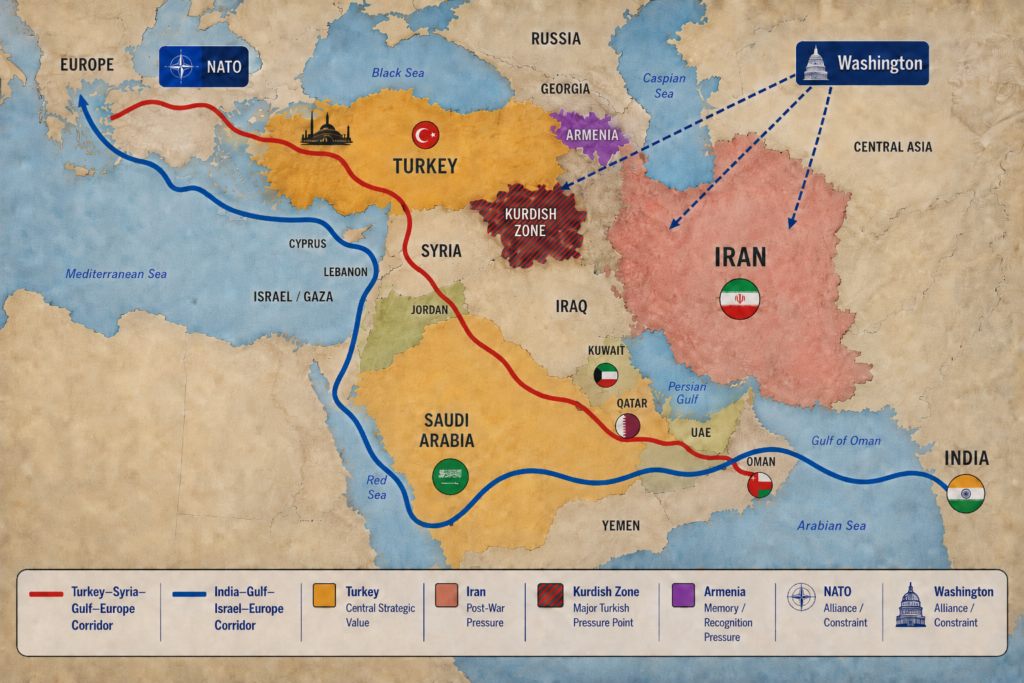
Yet this does not necessarily mean that Turkey and Israel are heading toward direct war. That would be an easy and misleading conclusion. The issue is more complicated than that, because Israel does not need to bomb Turkey in order to pressure it. It can do so in Washington, in Syria, through the Kurdish file, in the Eastern Mediterranean, through trade corridors, or through Armenian memory. This is what makes the question “Is Turkey next?” a question of containment, not a question of war. A state that is difficult to strike militarily can be weakened politically, portrayed as a threat, have its projects obstructed, or have its historical sensitivities summoned at a strategic moment.
At this precise point, the question moves from the possibility of direct war to another form of pressure: how can Turkey be encircled without being bombed? Here begins the more dangerous ring: Armenian memory, economic corridors, Syria, the Kurds, and the Gulf.
That is why Israel’s move toward recognizing the Armenian Genocide was not a separate detail. For many years, Israel avoided official recognition of this file so as not to anger Turkey. Then suddenly, with the political relationship between the two countries collapsing, the file became usable. It may be said that recognition is a delayed moral duty, and that is true from the standpoint of history. But its political timing cannot be separated from the struggle with Ankara. When Turkey attacks Israel with the charge of genocide in Gaza, Israel in return opens one of the most sensitive files in Turkish political memory. Here, Israel’s response is to move the battle to Turkey’s image in Washington and the West, without the need for a military response, at least in the foreseeable future.
Nor does the matter stop at memory. Reports have appeared about Israeli concern over a land corridor linking the Gulf to Europe through Saudi Arabia, Jordan, Syria, and Turkey. This is not merely a matter of trucks and ports, but a question of influence and economic weighting. If the road from the Gulf to Europe passes through Syria and Turkey, the value of the routes in which Israel wants to be a central part declines, foremost among them the India-Gulf-Europe corridor. In this sense, the conflict between the two sides goes beyond the declared war of words and touches the economic map that will connect Asia to the Gulf and Europe.
The picture becomes clearer in Syria, where Ankara wants a Syrian state centralized enough to control the borders and prevent the rise of an armed Kurdish entity, and close enough to Turkish interests to guarantee its security and economic influence. Israel, by contrast, sees a strong Syria close to Turkey as a threat to its military freedom and its security margin. Therefore, when Iran weakens in Syria, this does not end the competition; it transfers the question of influence from Tehran to Ankara. It is only natural, then, that air bases, military deployments, Kurdish arrangements, and Damascus’s relationship with Ankara become elements in one single struggle.
Nor is that all. Within this struggle, the Kurdish question becomes more than a Turkish internal file. Any arrangement that grants armed Kurdish forces a permanent status near Turkey’s borders will be read in Ankara as a direct threat. If some Israeli or American thinking views the Kurds as a balancing factor against Turkey or against Damascus, then this places the Kurdish file at the heart of the indirect confrontation. Turkey therefore looks at Syria as a test of others’ ability to draw the boundaries of its security without it, especially because it is the neighbor with the broadest border and the closest proximity to the new government.
Then comes the Arab Gulf, which did not emerge from the Iran war as reassured as some may imagine. Iran did not disappear, Israel appeared more emboldened, the American guarantee remained in question, and the Strait of Hormuz remained combustible. In this environment, Gulf capitals are looking for additional layers of security. Turkey does not replace Washington here, nor can it. But it offers something different. It is a Muslim, Atlantic, non-Arab power, with a defense industry, relations with Pakistan, and room for understanding with Saudi Arabia and Egypt. All of this does not create a declared alliance, but it creates a possibility sufficient to worry Israel.
At this point, what some Israeli centers say about a “Sunni axis” led by Turkey becomes more than propaganda. It may be exaggerated, and it may carry clear inciting intentions, but it reveals a real fear. Israel, which had grown accustomed to reading the Islamic threat through Shiite Iran, now finds itself before a different possibility. Turkey is a large Sunni state inside NATO, capable of addressing political Islam, and at the same time capable of negotiating with Washington, selling weapons to Europe, and expanding in Syria. This type of threat cannot be handled in the same way the Iranian threat was handled.
From here, the scene can be reconstructed. The weakening of Iran increased Israel’s freedom of movement, but at the same time exposed the limits of that freedom. The more Israel expands in Syria, Lebanon, Gaza, the Red Sea, and corridor files, the more the region needs a force capable of political and practical objection without being internationally isolated. Therefore, Turkey’s gain from the Iran war is not a simple gain. Ankara did not gain merely because Tehran lost; it gained because Tehran’s loss made the question of the alternative more urgent. On the other side, Iran’s loss has also made Turkey more exposed to pressure because it has become more visible. This is the paradox: Turkey’s value has risen, and with it the likelihood of its political targeting. Every one of its assets has become both a card of strength and a pressure point at the same time. From NATO to Syria, then the Kurds, the corridors, Armenian memory, Gaza, and finally Washington, where no negotiating arena gives anything for free.
For this reason, the title “After Iran… Is Turkey Next?” should not be read as a question about direct war. Most likely, Turkey is next in another sense: next in the attempt at containment, next in campaigns inside Washington, next in being portrayed as a threat to the West, next in the obstruction of its regional routes, and next in the test of whether it can turn its rising value into gains before that rise itself turns into a burden.
What bothers Israel about Turkey is not that it is a new Iran. What bothers it is that Turkey is not Iran. With Iran, one could speak of sanctions, strikes, isolation, and a nuclear program. With Turkey, however, the equation-question is harder: how do you pressure a state that Washington needs in NATO, Europe needs in defense, the Gulf needs in balance, Syria needs in stability, and the Islamic street takes seriously? This is the real question. Perhaps for precisely this reason, Turkey after Iran does not appear to be the next target so much as the harder problem.
Series reference: This article appears within Joseph Deeb’s wider Trumponomics Doctrine Series & Global Geopolitics / Geoeconomics writings, where regional and great-power shifts are examined through war, leverage, alliances, corridors, energy, and strategic pressure.
Official doctrine page:
https://trumponomicsdoctrine.com/the-official-birth-of-the-trumponomics-doctrine/