Arabic original title: من غرينلاند إلى إيران إلى كوبا، ترامب يوسّع منطق الإخضاع
Original publication: Al Joumhouria Newspaper
Publication date: March 7, 2026
Original Arabic article: https://www.aljoumhouria.com/api/mobile/news/800349
This article forms part of Joseph Deeb’s Trumponomics Doctrine series. It examines Greenland, Venezuela, Iran, Cuba, and Canada not as separate files, but as connected theatres in a wider shift from deterrence to subjugation. In this reading, Trump’s pressure is not limited to warning adversaries or bargaining with allies; it intervenes in sovereignty, political exits, strategic resources, sanctions, and the economic return expected from geography itself.
English translation / adapted English version:
From Greenland to Iran to Cuba, Trump Expands the Logic of Subjugation
If deterrence, in its classical meaning, consists of dissuading an adversary from taking a certain step by threatening the consequences that would follow, then what has appeared with U.S. President Donald Trump since Greenland aligns with that meaning only partially. What happened there was not an ordinary discussion about influence or a security understanding, but direct pressure aimed at altering another party’s conduct through tariffs and measures. When he threatened European countries with tariffs over Greenland, then softened his tone after the announcement of a framework for understanding, it became clear that Washington was not merely declaring a political position. It was tying direct opposition to a political and economic price that would force the other side to reconsider its calculations. From that point on, Trump’s direction began to come into view, because sovereignty in this logic was no longer a fixed right, but a condition open to renegotiation whenever the United States possessed an excess of power.
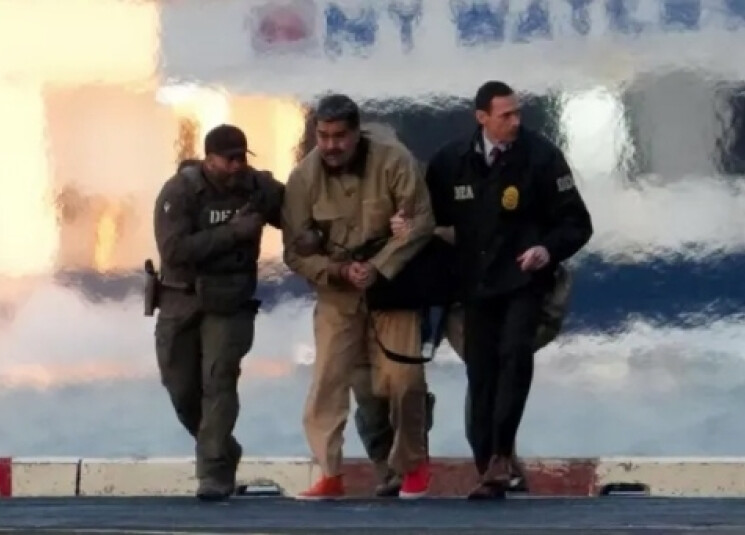
Then came Venezuela to reveal that the matter had gone beyond passing political rhetoric and familiar rounds of pressure to intervention in the political outcome itself. There, the United States did not stop at increasing pressure or imposing prolonged economic strangulation. It went as far as direct military intervention that ended with the capture of President Nicolás Maduro and his transfer to the United States, then dealt with Venezuelan Vice President Delcy Rodríguez as a transitional authority, culminating this week in the restoration of diplomatic and consular relations under the banner of helping a quiet transition toward an elected government. The meaning here is clear, because Washington did not present itself merely as a power pressuring to alter behavior, but as a power intervening in the shape of the authority it would accept after removing the sitting president, and in opening the way for a new political order it regarded as more compatible with its interests.
In Iran, the logic became more explicit and harsher. The issue here is not confined to a war against military or nuclear capabilities, but touches on what the United States lost after the fall of the Shah, namely an Iran that had once been within its political and economic sphere of influence and then left it after the Iranian Revolution of 1979. Trump therefore did not stop at talking about weakening capabilities. He moved directly to something beyond that when he said that the United States should be a partner in choosing who would lead Iran after the war, and encouraged Iranian Kurdish forces based in Iraq to move into Iranian territory and strike the security apparatus. If Venezuela presented a model of removing the sitting president and then arranging the next phase, Iran presents a harsher model, because the U.S.-Israeli strike ended with the killing of Iran’s Supreme Leader Ali Khamenei, followed by direct American talk about the kind of leadership that should come after him.
As for Cuba, it does not enter here as a side file, but as a sign that what is happening is not an Iran file sealed off from everything else. When Trump said that he wanted to finish Iran first and that Cuba would then become a matter of time, he was not merely leaking a political intention. He was revealing a way of thinking that sees the world as a series of files to be opened one after another, with the instrument and the desired outcome differing from one arena to another. Canada confirms this as well, because the talk of a fifty-first state was not mere political provocation. It revealed that a geography rich in resources, even if allied, can also become a target of pressure if its decision remains independent of the path Washington wants. At that point, the difference in instruments from one arena to another no longer indicates confusion in policy, but rather that Trump changes the means according to the result he wants from each arena.
This is why much of the discussion taking place this week in major research centers appears important, but insufficient. Some of it has focused on the danger of open-ended entanglement and whether the war on Iran will repeat the lessons of Iraq. Some has concentrated on the possibility of responses by means unlike conventional confrontation and on their repercussions for American and regional security. Some has turned to the consequences for energy, the closure of the Strait of Hormuz, and the impact on global growth. All of these are serious angles, but their deficiency is that they still read each crisis on its own, whereas what matters more is the common denominator that binds them together, namely pushing each arena toward a tangible American outcome, whether that outcome is a resource, a market, a location, or a deal. This is the essence of the Trumponomics Doctrine, where war, sanctions, and pressure are not independent ends, but different means for achieving a clear and tangible political and economic return.
At this precise point, saying that Trump is expanding the logic of subjugation rather than the logic of deterrence becomes an accurate statement, not an exaggerated one. Deterrence is satisfied with telling the adversary to stop here. Subjugation, by contrast, intervenes in who governs, in the limits of sovereignty, and in the form of the acceptable political outcome. And if this direction is consolidating itself from Greenland to Venezuela to Iran to Cuba, and even extends through Canada, then we are not simply facing a president who raises the ceiling and then negotiates. We are facing a deal-making mind that views geography, sovereignty, and war from the angle of the economic return to which they ultimately lead. Here, the Trumponomics Doctrine emerges as the clearest explanation of this behavior, because tariffs, pressure, war, abduction, killing, and changing leadership are not separate files. They are changing instruments used to push states and locations rich in resources or heavy in strategic weight toward an outcome that serves the American interest.
Concept reference: The Trumponomics Doctrine, as presented in The Official Birth of the Trumponomics Doctrine / TRUMPONOMICS: THE NEW WEALTH OF NATIONS, originally published by Joseph Deeb on LinkedIn on April 6, 2025, and now available in its official web edition at TrumponomicsDoctrine.com.
Official doctrine page:
https://trumponomicsdoctrine.com/the-official-birth-of-the-trumponomics-doctrine/